MLB Rule 21 Gambling Policy: Player Bans and Wagering Restrictions
 Available in US
Table of Contents
- Rule 21 History: Baseball’s Gambling Relationship Since 1927
- What Rule 21 Actually Says: Section by Section
- Penalty Tiers: One Year, Permanent Ineligibility, and the 2025 Death-Clause Amendment
- Who Falls Under Rule 21: Players, Coaches, Umpires, and Club Employees
- Legal Sportsbook Use and the Gray Areas Rule 21 Does Not Explicitly Address
- How Enforcement Works: From Detection to Discipline
- Should Rule 21 Be Modernized for the Legal Betting Era?
Rule 21 History: Baseball’s Gambling Relationship Since 1927
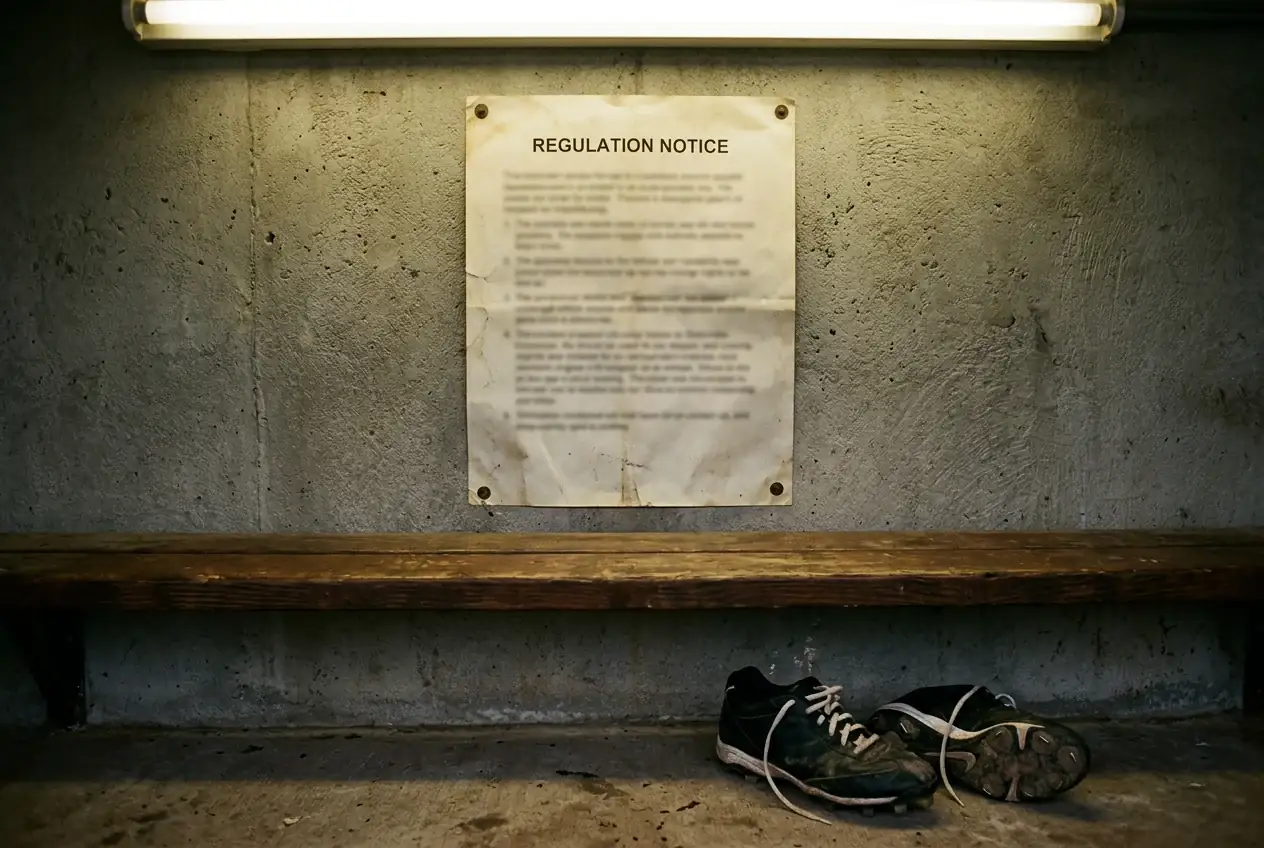
Walk into any Major League clubhouse in America and you will find a posted notice that has not fundamentally changed in almost a century. Rule 21, the gambling regulation that governs every person in professional baseball, is printed and displayed where players cannot avoid seeing it. I have always found that detail revealing. The rule does not live in a handbook that sits on a shelf. It is mounted on a wall, eye level, a daily reminder that baseball’s relationship with gambling is not a chapter from the past but an active, enforceable present.
The rule was born from crisis. After the 1919 Black Sox scandal nearly destroyed public trust in the sport, baseball’s first commissioner, Kenesaw Mountain Landis, established the framework that would become Rule 21. The logic was simple: if the game could be bought, the game was worthless. Every amendment since then — and there have been surprisingly few — has reinforced that original premise while trying to keep pace with a gambling landscape that looks nothing like the one Landis confronted.
In 2025, that pace finally outran the rule. The Clase pitch-fixing indictment, the Marcano lifetime ban, and the explosive growth of legal sports wagering across 39 states forced a reckoning with what Rule 21 actually covers, what it misses, and whether a regulation designed for an era of backroom bookmakers can function in one where anyone with a phone can place a bet on whether the next pitch is a ball or a strike. This is a section-by-section examination of the rule that defines MLB players’ betting boundaries — what it says, who it covers, and where the gray areas are wide enough to drive a scandal through.
What Rule 21 Actually Says: Section by Section
Rule 21 is shorter than most people expect. The full text fits on a single page, and its structure reflects the blunt clarity of a regulation written in the shadow of a near-fatal crisis. The rule divides gambling conduct into categories with escalating consequences, and the language has remained remarkably stable since its original adoption.
The first tier addresses betting on any baseball game by anyone subject to the rule. This is the broadest prohibition. Any bet on any MLB game — not just your own team’s games — triggers a mandatory one-year suspension. The rule does not distinguish between a £7.9 wager and a £7,900 wager, between a bet placed at a legal sportsbook and one placed through an illegal channel. The act of betting on a baseball game, regardless of amount or method, is a violation.
The second tier raises the stakes dramatically. Betting on a game in which the individual has a duty to perform — meaning a player betting on a game involving his own team, or an umpire betting on a game he is scheduled to work — triggers permanent ineligibility. This is the “lifetime ban” that headlines reference, though the rule’s actual language is more clinical. Permanent ineligibility removes the individual from all organized professional baseball: no playing, no coaching, no front-office work, no affiliation of any kind.
The third tier covers game-fixing and bribery. Any attempt to influence the outcome of a game for gambling purposes, or any acceptance of a bribe to do so, results in permanent ineligibility. This is the provision that applied to the Black Sox and that the Clase indictment implicates, though the federal criminal charges operate on a separate legal track from MLB’s internal disciplinary process.
Beyond these core tiers, Rule 21 includes provisions addressing gifts, associations with known gamblers, and failure to report attempted bribery or corruption. Commissioner Manfred emphasized the enforcement rationale when announcing the Marcano ban, describing strict application of gambling rules as essential to protecting the integrity of MLB’s games. The language is deliberately severe because the drafters understood something that remains true: the rule’s deterrent power depends on the certainty of its consequences, not the nuance of its exceptions.
Penalty Tiers: One Year, Permanent Ineligibility, and the 2025 Death-Clause Amendment
I have lost count of the number of times someone has asked me whether a lifetime ban really means lifetime. The answer, until recently, was an unqualified yes — with one strange exception that nobody talked about. Permanent ineligibility had no mechanism for ending. A banned player could apply for reinstatement after one year, but the commissioner had absolute discretion to deny the application, and every commissioner since Landis had exercised that discretion with an iron hand. Pete Rose applied, was denied, and died on the ineligible list. No one banned for betting on baseball had ever been restored through the standard reinstatement process.
The one-year suspension tier functions differently. Players found to have bet on baseball games not involving their own team receive a defined suspension with an automatic return date. Four players suspended alongside Marcano in 2024 fell into this category — they had placed bets on MLB games but not on their own teams. They served their suspensions and returned to eligibility without needing to petition the commissioner.
The 2025 death-clause amendment introduced a genuinely new wrinkle. On 13 May 2025, Commissioner Manfred announced that permanent ineligibility would henceforth terminate upon the death of the banned individual. The practical effect was the posthumous reinstatement of several players from the Black Sox era and adjacent scandals. The amendment was narrow — it changed nothing for living banned individuals — but it resolved a philosophical absurdity that had lingered for a century. Under the old rule, a player banned in 1920 remained on the ineligible list forever, even a hundred years after his death. The amendment acknowledged that punishment serves no purpose beyond the grave.
What the amendment did not change is the core penalty structure for active violations. Betting on your own game still means permanent ineligibility. Fixing a game still means permanent ineligibility. The deterrent remains as stark as it was in 1927. The question is whether starkness alone is sufficient when the opportunities to violate the rule have multiplied a hundredfold.
Who Falls Under Rule 21: Players, Coaches, Umpires, and Club Employees
Rule 21’s jurisdiction is broader than most fans realize. The regulation does not apply only to the 750 players on active major-league rosters. It covers every individual who is part of organized professional baseball’s ecosystem, and that net is cast wide.
Players at every level — major league, minor league, and developmental — fall under Rule 21. This matters because the minor leagues contain thousands of athletes, many of them earning modest salaries and facing the same mobile-betting temptations as their major-league counterparts, but with fewer resources, less media scrutiny, and arguably more financial pressure. Marcano was a major-leaguer when his ban was announced, but several of the players suspended in the same investigation were minor-leaguers. The rule draws no distinction based on service level.
Coaches, managers, and uniformed staff are covered with the same prohibitions and penalties. An MLB manager betting on his own team’s games would face the same permanent ineligibility as a player. This is the provision that made the Pete Rose case so definitive — Rose was managing the Reds, not playing for them, when the Dowd Report documented his betting activity. His duty to perform extended to every strategic decision he made from the dugout.
Umpires are explicitly included, which makes sense given their direct ability to influence game outcomes through ball-strike calls, safe-out decisions, and replay review judgments. Front-office executives, club employees, and anyone with a formal relationship to an MLB organization also fall within the rule’s scope. Since the 2018 expansion of legal betting, MLB has extended educational programs and monitoring to all of these groups, but the practical challenge of policing thousands of individuals across 30 organizations and their minor-league affiliates is enormous.
One group that sits in an awkward position: player agents, family members, and close associates who are not directly employed by a team. Rule 21 addresses “associations with known gamblers” but does not explicitly cover everyone in a player’s orbit the way it covers club employees. The Ippei Mizuhara case — in which Shohei Ohtani’s interpreter stole £13.4 million to fund gambling debts — highlighted this gap. Mizuhara was not a player and was not placing bets on baseball, but his proximity to the sport’s biggest star and his exploitation of that access exposed a vulnerability that Rule 21 was not designed to address. At least 20 athletes across the five major professional leagues have been disciplined for gambling violations since 2018. The individuals around them remain a largely unregulated gray zone.
Legal Sportsbook Use and the Gray Areas Rule 21 Does Not Explicitly Address
Here is where things get genuinely complicated. Rule 21 prohibits betting on baseball. It does not prohibit betting on everything. An MLB player can, in principle, walk into a legal sportsbook in a state where sports wagering is permitted and place a bet on an NFL game, an NBA game, or a tennis match without technically violating the rule’s text. The prohibition targets baseball-specific wagers, not all gambling activity.
In practice, MLB has layered additional policies on top of Rule 21 that discourage broader sports betting by players. Educational programs warn against any sportsbook activity. Club policies may impose restrictions that go beyond the rule’s letter. But the formal language of Rule 21 itself is narrower than people assume, and that gap between the rule and the broader policy creates a gray area that has not been tested in a high-profile enforcement action.
The rise of prediction markets has introduced another ambiguity. Platforms operating under different regulatory frameworks now offer contracts on sporting events that function like bets but are classified as event contracts rather than traditional wagers. Whether a player purchasing a prediction market contract on a non-baseball event would violate Rule 21 — or any of MLB’s supplementary policies — is an open question that nobody in the commissioner’s office has publicly addressed.
Daily fantasy sports present a similar boundary issue. MLB has official partnerships with daily fantasy operators, and players are not explicitly prohibited from participating in fantasy contests, though most choose not to for appearances. The line between a fantasy contest and a prop bet has blurred considerably as fantasy platforms have added features that look increasingly like single-game wagers. University of Michigan sport management professor Michal Lorenc has noted that sports betting rules will likely be relaxed over the coming years as the legal landscape continues to evolve, suggesting these gray areas may be resolved through liberalization rather than restriction.
The fundamental tension is structural. Rule 21 was written for a binary world: either you bet on baseball or you did not. The modern betting ecosystem is a spectrum of products — props, micro-bets, prediction markets, daily fantasy, social betting — and Rule 21’s bright lines do not map cleanly onto that spectrum. Every gray area is a potential future scandal waiting for the wrong person to test it.
How Enforcement Works: From Detection to Discipline
A rule is only as strong as the mechanism that enforces it, and Rule 21’s enforcement pipeline has evolved significantly since the days when Commissioner Landis operated on instinct and newspaper tips. Today, MLB maintains a Department of Investigations — a dedicated internal unit that functions as the sport’s gambling police — and partners with third-party integrity firms and sportsbook operators to monitor betting activity.
The Marcano case illustrated the modern enforcement pathway. Sportsbook transaction records flagged a pattern of baseball bets placed by an account linked to an active player. The Department of Investigations obtained the records, corroborated the activity, and built a case that resulted in a permanent ban. The process relied on the cooperation of a legal sportsbook operator, which was required by its licensing agreement to share data with league integrity monitors. Marcano placed 387 bets totaling more than £118,500, and his win rate on MLB-linked wagers was just 4.3 percent — a detail that underscored the compulsive nature of the behavior rather than any sophisticated scheme.
The Clase case exposed the enforcement model’s limits. The alleged pitch-fixing scheme did not involve a player placing bets under his own name. It involved a player allegedly manipulating on-field actions while co-conspirators placed wagers. This is a fundamentally harder pattern to detect because the suspicious activity occurs on two separate tracks — the betting market and the playing field — and connecting them requires analysis that goes beyond transaction monitoring. MLB’s internal system did not catch Clase. Federal law enforcement did, through a wire fraud investigation that originated outside baseball’s monitoring infrastructure.
The gap between what Rule 21 prohibits and what the enforcement apparatus can actually detect in real time is the central vulnerability of the entire framework. The rule is clear. The penalties are severe. The monitoring is improving but structurally reactive. Enforcement works when bettors are careless. It struggles when they are not.
Should Rule 21 Be Modernized for the Legal Betting Era?
Should Rule 21 be rewritten? I have been wrestling with this question for the past two years, and I keep arriving at the same uncomfortable conclusion: the rule is both too strict and too narrow at the same time.
It is too strict in the sense that permanent ineligibility for any bet on any baseball game, regardless of context, may not be a proportionate response in an era when legal sportsbooks advertise inside MLB stadiums and the league collects millions in partnership revenue from the same operators it expects players to avoid entirely. Commissioner Manfred himself acknowledged this tension when he noted that MLB was dragged into legalized sports betting as a litigant in the PASPA case, but that legalization had made monitoring easier than policing an illegal market. That pragmatic acceptance of the new reality sits awkwardly next to a rule that treats a £15.8 bet on a game you are not playing in the same way it treats fixing a World Series.
It is too narrow in that the rule was built around a single threat model — a player betting on or throwing his own games — and has not been structurally updated to address micro-bets, pitch-level manipulation, intermediary schemes, or the broader ecosystem of betting-adjacent products that now surrounds the sport. The Clase case did not fit neatly into Rule 21’s framework because the rule does not explicitly contemplate a scenario where a player manipulates a single pitch for the benefit of a third-party bettor on a market that did not exist when the rule was written.
Reform proposals generally fall into two camps. The first advocates for modernising the rule’s language to explicitly address new market types, intermediary schemes, and betting-adjacent products, while maintaining the current penalty structure. Under this approach, the rule would name micro-bet manipulation, signal-sharing with third-party bettors, and exploitation of prediction market platforms as specific offenses, closing the language gaps that current and future schemes might exploit. The second camp argues for a graduated penalty system that distinguishes between passive gambling violations and active manipulation of game outcomes, reserving permanent ineligibility for the most serious offenses while allowing for proportionate responses to lesser violations.
Neither camp has gained meaningful traction with the commissioner’s office, which has publicly signaled that Rule 21’s severity is the point. The rule is designed to be harsh enough that no rational actor would risk triggering it. The problem, as this timeline of scandals demonstrates, is that rational calculation has never been the only force at work. Compulsion, arrogance, financial pressure, and the sheer accessibility of modern betting have driven every recent violation, and a rule built on deterrence cannot deter someone who is not weighing consequences before they act.
The likeliest near-term outcome is not a rewrite but an accretion of supplementary policies — the micro-bet caps, the enhanced monitoring requirements, the expanded educational programs — layered on top of Rule 21 without changing its core text. That is how baseball has always adapted: not by rebuilding the foundation, but by adding rooms to the house until the structure groans. Whether the house holds depends on whether the next scandal fits within the existing walls or blows through them entirely.
Can MLB players legally place bets at sportsbooks on non-baseball events?
Rule 21 specifically prohibits betting on baseball games. It does not, in its formal text, ban all sports betting. An MLB player could theoretically wager on an NFL or NBA game at a legal sportsbook without violating Rule 21’s letter. However, MLB’s supplementary policies and educational programs strongly discourage any sportsbook activity by players, and individual clubs may impose additional restrictions beyond the rule’s text.
Does Rule 21 apply to minor-league players and front-office staff equally?
Yes. Rule 21 covers everyone in organized professional baseball, including minor-league players at all levels, coaches, managers, umpires, front-office executives, and club employees. The same prohibitions and penalty tiers apply regardless of the individual’s role or level within the organization.
How has Rule 21 changed since PASPA was repealed in 2018?
The core structure of Rule 21 has remained largely intact since its original adoption. The most significant recent amendment came in May 2025, when Commissioner Manfred added a provision ending permanent ineligibility upon the death of the banned individual, leading to the posthumous reinstatement of several Black Sox-era players. MLB has also expanded educational programs and monitoring infrastructure since 2018, but the rule’s text has not been overhauled to address new market types like micro-bets or prediction markets.
What is the appeals process for a player banned under Rule 21?
A player placed on the permanently ineligible list may apply for reinstatement after one year. The application is reviewed by the commissioner, who has absolute discretion to grant or deny it. There is no formal appeals tribunal or independent review body. Every reinstatement petition in MLB history related to gambling violations has been denied during the petitioner’s lifetime.
Prepared by the mlb Players Betting editorial staff.