MLB Player Props Strategy: Value in Strikeouts and Home Runs
 Available in US
Table of Contents
- MLB Player Props EV: Analyzing Strikeouts and Total Bases
- Pitcher Strikeout Lines: What Drives the Number
- Home Run and Total Bases Props: Park Factors and Platoon Splits
- Why Line-to-Projection Gaps Signal Value in Props
- Same Game Parlays and NRFI: Correlated Markets Explained
- Comparing Odds Across Sportsbooks for Baseball Props
- Five Analytical Traps in MLB Prop Betting
MLB Player Props EV: Analyzing Strikeouts and Total Bases
Three years ago, if someone told me that individual pitch outcomes would become the fastest-growing corner of the sports betting market, I would have questioned their grip on reality. Player proposition bets — wagers on individual statistical performances rather than game results — were a niche curiosity for most of legal betting’s short history. Then baseball discovered what the market already knew: a 162-game season with discrete, measurable events happening hundreds of times per contest is a proposition bettor’s paradise.
Today, roughly 90 percent of sports wagers are placed on mobile devices, and more than half of those bets happen live, during the game itself. That shift in how people bet has driven an explosion in player prop markets. Strikeout totals, home run props, total bases, hits, walks — every quantifiable action a baseball player takes on the field now has a corresponding betting line. The growth has been so rapid that it has reshaped how sportsbooks structure their MLB offerings and, more quietly, created the very integrity vulnerabilities that led to the Clase pitch-fixing indictment in 2025.
This guide is not about picking winners for tonight’s slate. I have spent years building analytical frameworks for evaluating these markets, and what I want to share here is the structural thinking that separates informed bettors from the crowd. How are strikeout lines actually set? What makes a home run prop mispriced? Where do park factors, platoon splits, and projection models create genuine gaps between the line and the true probability? If you are looking for the broader context of MLB players betting scandals and how prop markets fuel integrity risks, that piece covers the full landscape. Here, we go narrow and deep into the strategy.
A word of context before we begin. The sportsbook industry collected £13.40 billion in gross gaming revenue in 2025 — a record, and a 22.8 percent increase over the prior year. That money comes from somewhere. It comes from bettors, and it comes disproportionately from bettors who approach these markets without a framework. Having a framework does not guarantee profit. Nothing does in a market with a built-in house edge. But it changes the conversation from gambling to analysis, and in my experience, that distinction matters more than any individual bet.
Beyond individual player performances, many sharp bettors focus on No Run First Inning (NRFI) betting strategies for quick and exciting payouts.
Pitcher Strikeout Lines: What Drives the Number
Every MLB prop bettor eventually gravitates toward strikeouts, and for good reason. Pitcher strikeout lines are the most liquid, most frequently offered, and most analytically tractable player prop in baseball. They are also the market where the most money changes hands, which means the lines are sharp — but not impenetrable.
A sportsbook sets a strikeout over/under by starting with the pitcher’s expected workload. A starter projected to throw six innings faces roughly 24 batters. His strikeout rate — expressed as K per nine innings or K percentage — is applied to that projected batter count to produce a baseline number. If a pitcher strikes out 27 percent of batters faced and is expected to see 24 hitters, the raw projection is about 6.5 strikeouts. The line gets adjusted from there based on the opposing lineup’s strikeout tendencies, the home plate umpire’s zone, and the game environment.
The opposing lineup is the single largest variable after the pitcher himself. A team that ranks in the top five in strikeout rate — meaning they whiff often — can push a pitcher’s expected total up by a full strikeout compared to a bottom-five contact team. I track this using opposing team K rate against left-handed or right-handed pitching specifically, because the aggregate number masks platoon effects. A lineup that strikes out 25 percent of the time against right-handers but only 20 percent against lefties produces very different prop expectations depending on who is on the mound.
Umpires matter more than most casual bettors realize. Home plate umpires with larger strike zones inflate strikeout totals across the board, sometimes by 0.5 to 1.0 strikeouts per game compared to tight-zone umpires. The data is publicly available, updated daily, and criminally underused. When I see a high-K pitcher facing a strikeout-prone lineup with a generous umpire behind the plate, the over on the strikeout line becomes one of the most reliable edges in baseball prop betting. When two of those three factors point in the other direction, I stay away regardless of the pitcher’s name.
Workload projection is the hidden trap. Sportsbooks build their lines assuming a certain number of innings, but managers pull starters earlier than ever. A pitcher with elite stuff might have a strikeout rate that screams “over” — until he gets yanked after five innings because he threw 95 pitches and has a start in four days. Monitoring pitch-count tendencies, bullpen availability, and the team’s position in the standings gives you a better workload estimate than the line implies, and that estimate drives everything else.
Home Run and Total Bases Props: Park Factors and Platoon Splits
Home run props are the slot machines of baseball betting — high variance, big payoffs, and a magnetic pull that makes people overbet them. I say that as someone who has spent an embarrassing amount of time building models to find edges in this exact market. The truth is, home run props are harder to beat consistently than strikeouts because the base rate is low. Even the best power hitters go deep in roughly 5 to 7 percent of their plate appearances. A 0.5-strikeout mispricing is exploitable over volume; a 1-percent edge on whether a batter hits a home run in a given game dissolves into noise faster than you would like.
That said, park factors create real, persistent mispricings. Coors Field in Denver inflates home run rates by 30 to 40 percent compared to league average. Great American Ball Park in Cincinnati, Yankee Stadium with its short right-field porch, and Citizens Bank Park in Philadelphia all run significantly above neutral. Conversely, Oracle Park in San Francisco, with its deep outfield and heavy marine air, suppresses fly balls. These factors are not secrets, but sportsbooks sometimes underprice the adjustment, especially for visiting players whose park-neutral numbers are what the market knows best.
Platoon splits deserve their own paragraph because they are the single most reliable filtering tool for total bases props. A right-handed batter facing a left-handed pitcher produces, on average, significantly more power output than the same batter facing a right-hander. The reverse is also true. Total bases — a market that rewards singles, doubles, triples, and home runs on a sliding scale — is where platoon advantages compound. A batter with a .550 slugging percentage against opposite-hand pitching and a .380 mark against same-side arms is functionally two different hitters depending on the matchup. If the sportsbook sets one total bases line for the day without fully weighting the platoon split, the gap is your edge.
Weather and game-time conditions add a final layer. Wind blowing out at Wrigley Field is the classic example, but humidity, temperature, and altitude all affect ball flight. Games played in temperatures above 28 degrees Celsius produce measurably more home runs than games in cooler conditions. These adjustments are small individually but cumulative — park plus platoon plus weather can shift a total bases projection by half a base or more, which is often the margin between a well-priced line and a mispriced one.
Why Line-to-Projection Gaps Signal Value in Props
The single most useful habit I have developed in nearly a decade of this work is comparing sportsbook lines to independent projections before placing any bet. Not because projection systems are infallible — they are not — but because the gap between what a model expects and what the sportsbook is offering tells you whether the market has left money on the table.
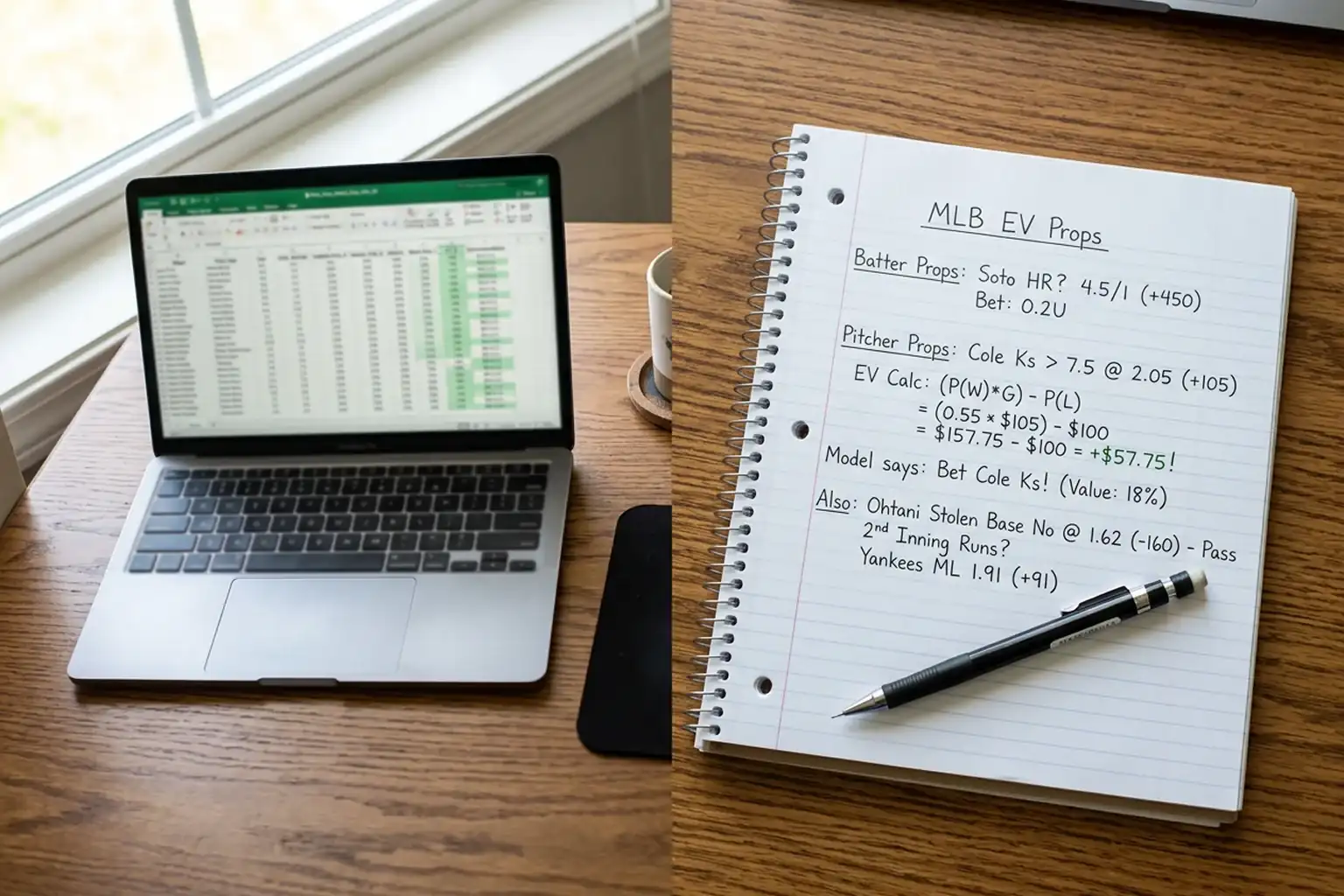
Here is how this works in practice. Suppose a projection system estimates a pitcher will record 7.1 strikeouts tonight. The sportsbook posts the over/under at 6.5 with the over priced at -120. The model’s projection sits above the line, which means the over has value — but only if the gap is large enough to overcome the built-in margin the sportsbook charges. That margin, known as the vig or juice, is the difference between fair odds and the odds you actually get. A -120 price on the over implies you need to win that bet roughly 54.5 percent of the time to break even. If your projection suggests the over hits 58 percent of the time, the gap is real. If it suggests 55 percent, the edge is too thin to survive variance.
The average sportsbook win rate across all sports hit a record 9.7 percent in 2025. That number represents the collective margin baked into every line, every market, every prop. It means the average bettor is paying nearly ten pence on every pound wagered for the privilege of playing. Beating that margin requires finding line-to-projection gaps that are larger than the vig — and finding them consistently enough to survive the inevitable losing streaks.
I use multiple projection sources rather than relying on a single model, because each system weights inputs differently. One may lean heavily on recent form; another may prioritize career platoon data. When two or three independent projections all point in the same direction and the sportsbook line disagrees, the signal is stronger. When projections diverge, I treat the line as efficient and move on. The integrity dimension of this market — how MLB monitors suspicious betting activity around prop lines — adds another layer of context that any serious prop bettor should understand.
Discover advanced analytics and winning formulas on our trusted baseball wagering hub.
Same Game Parlays and NRFI: Correlated Markets Explained
Same game parlays have become the most marketed bet type in baseball, and that alone should make you cautious. Sportsbooks do not promote products that favor the bettor. They promote products that generate revenue, and SGPs — multi-leg wagers where all selections come from a single game — are enormously profitable for the house. A study of nine million bettors during the 2023-2024 NFL season found that 60 percent of bettors generated just 1 percent of sportsbook revenue. The heavy losses came disproportionately from parlay bettors chasing long-shot payouts.
The conceptual appeal of SGPs in baseball is correlation — the idea that certain outcomes within the same game are linked and should be combined. If a starting pitcher is dominant, the game total is more likely to go under and the opposing team’s hitters are less likely to reach their prop lines. Those legs are genuinely correlated. But sportsbooks know this and adjust the parlay odds accordingly, reducing the payout compared to what you would get if the legs were treated as independent. The question is whether their correlation adjustment is accurate, too aggressive, or not aggressive enough. In my experience, books are increasingly precise at pricing correlation, which means the mathematical edge in SGPs is smaller than the payout structure suggests.
NRFI — No Run First Inning — is the other correlated market that has exploded in popularity. It is a binary bet: either a run scores in the first inning or it does not. The appeal is speed. An NRFI bet resolves in roughly ten minutes, which feeds the dopamine cycle that mobile betting thrives on. Analytically, the key inputs are starting pitcher first-inning ERA, opposing lineup on-base percentage in the first inning, and park scoring environment. A matchup between two elite starters in a pitcher-friendly park can push the NRFI probability above 70 percent, which occasionally creates value when the line does not reflect the full matchup context.
The integrity dimension is worth noting. Sports agent Scott Boras put the problem bluntly when discussing prop bets and first-inning markets: a pitcher overthrowing a single pitch now invites suspicion in a way it never did before, and removing certain prop bets is necessary to protect players from having their integrity questioned. NRFI markets concentrate enormous betting volume on a tiny slice of the game, which makes them both analytically interesting and structurally vulnerable to the kind of manipulation that has already surfaced elsewhere in baseball’s betting ecosystem.
Comparing Odds Across Sportsbooks for Baseball Props
If I could give one piece of advice to anyone serious about MLB prop betting, it would be this: open accounts at multiple sportsbooks and compare lines before every bet. Line shopping is the closest thing to a free edge that exists in sports betting, and most people do not bother.
The reason is simple. Different sportsbooks use different models, different trader inputs, and different risk management strategies. A pitcher’s strikeout line might be 6.5 at one book and 7.5 at another, with the odds adjusted accordingly. The price on the same side of the same number — say, over 6.5 strikeouts — can vary by 15 to 20 pence between operators. On a £79 bet, the difference between -130 and -110 on the same outcome is roughly £3.16 in expected return. That adds up over hundreds of wagers into a significant improvement in long-term results.
Sportsbook revenue hit £13.40 billion in gross gaming revenue in 2025, a 22.8 percent jump from the prior year. That revenue comes from bettors who accept the first price they see. The sportsbooks’ aggregate margin — that record 9.7 percent win rate — is an average across all bettors. Bettors who consistently shop for the best line reduce their effective vig, which narrows the gap they need to overcome to be profitable. It is not glamorous analysis. It will not make for a good pub story. But it works.
For baseball props specifically, I have noticed that smaller-market pitchers tend to show wider line discrepancies across books than marquee names. The market is more efficient for a pitcher who throws in front of a national audience every five days than for a mid-rotation arm on a small-market team. That inefficiency is your friend. When I find a prop line that is half a strikeout different at two books on a mid-rotation starter, I know the market has not converged, and one of those prices is softer than it should be.
The practical barrier is time. Checking four or five sportsbooks for every prop bet adds ten minutes to the pre-bet process. Most recreational bettors will not do it. That is precisely why the edge persists — it requires effort, not insight. Dedicated line-comparison tools and odds aggregation sites can speed this up, but the habit of never accepting the first price you see is the real competitive advantage. Every cent you save on vig compounds across a season of 2,430 regular-season games, each with dozens of prop markets. The cumulative effect is the difference between a losing year and a break-even one for many bettors.
Five Analytical Traps in MLB Prop Betting
After years of analyzing my own results and watching others make the same errors, I have distilled the most common analytical traps in MLB prop betting into five categories. Each one has cost me money at some point. I share them here not as abstract warnings but as scars.
The first trap is recency bias. A pitcher strikes out 12 batters in his last start, and suddenly the over on his strikeout line looks like a lock. But one game is noise. Strikeout rates stabilize over roughly 150 batters faced — about six or seven starts. Using a sample smaller than that to override a season-long projection is a reliable way to bet into inflated lines that the sportsbook has already adjusted to capture the public’s enthusiasm.
The second is ignoring the vig when calculating edges. A bet that wins 52 percent of the time sounds profitable until you realize you are paying -110 or worse, which requires 52.4 percent just to break even. Many bettors compare their projection to the line without accounting for the price, which means they are betting into negative expected value while believing they have found an edge.
Third: treating park factors as static. Coors Field is always hitter-friendly, but wind direction, game-time temperature, and humidity shift the magnitude of the effect from game to game. A blanket “add 20 percent for Coors” adjustment is lazy and often wrong in specific conditions. The same applies to every other park. I check game-time weather forecasts within two hours of first pitch before finalising any park-adjusted projection.
Fourth is the narrative trap. Baseball media produces compelling stories — a rookie’s debut, a rivalry game, a pitcher coming off the injured list — and those stories create emotional gravity that pulls bettors toward certain sides. The market knows this. Lines on high-profile narratives are often the sharpest, most efficient prices on the board, because the sportsbook anticipates one-sided public action and adjusts preemptively. Betting against the narrative is not always correct, but betting into it without checking the numbers is almost always expensive.
The fifth trap is over-parlaying props instead of betting them individually. The expected return on any parlay is lower than the sum of its parts because the sportsbook takes a margin on the correlation adjustment and on each individual leg. Single bets compound edges. Parlays compound vig. The math is not debatable, but the allure of a big payout makes people ignore it every day.
What are the best MLB player props to bet on for consistent value?
Pitcher strikeout props offer the most consistent analytical edge because the key inputs — pitcher K rate, opposing lineup strikeout tendency, and umpire zone — are publicly available and relatively stable. Total bases props for hitters with strong platoon splits facing opposite-hand pitchers also produce repeatable value, especially when park factors and weather conditions align favorably.
How do park factors affect MLB home run prop lines?
Park factors significantly influence home run probability. Venues like Coors Field in Denver inflate home run rates by 30 to 40 percent above league average, while parks like Oracle Park in San Francisco suppress them. Sportsbooks account for park effects but sometimes underprice the adjustment for visiting players whose baseline numbers reflect a neutral park mix. Checking park-specific home run rates by batter handedness adds further precision.
What makes a same-game parlay leg genuinely correlated in baseball?
Genuine correlation exists when one outcome directly influences another within the same game. A dominant starting pitcher performance correlates with a lower game total and reduced offensive props for the opposing lineup. A high-scoring game environment correlates with inflated hit and total bases numbers for both teams. The key test is whether knowing the result of one leg changes the probability of another. If the connection is logical and directional, the correlation is real. If it relies on a narrative rather than a mechanical link, it is likely not priced as an edge.
Written by the editors at mlb Players Betting.